 In this area
The Naples issue
Montesanto, Naples: the market district that never lowers its voice
A loud, local, transport-hub neighbourhood where Naples shops, fries, and changes trains in the same breath.
By Gennaro EspositoPizza queues and two-euro cuoppi, at full volume
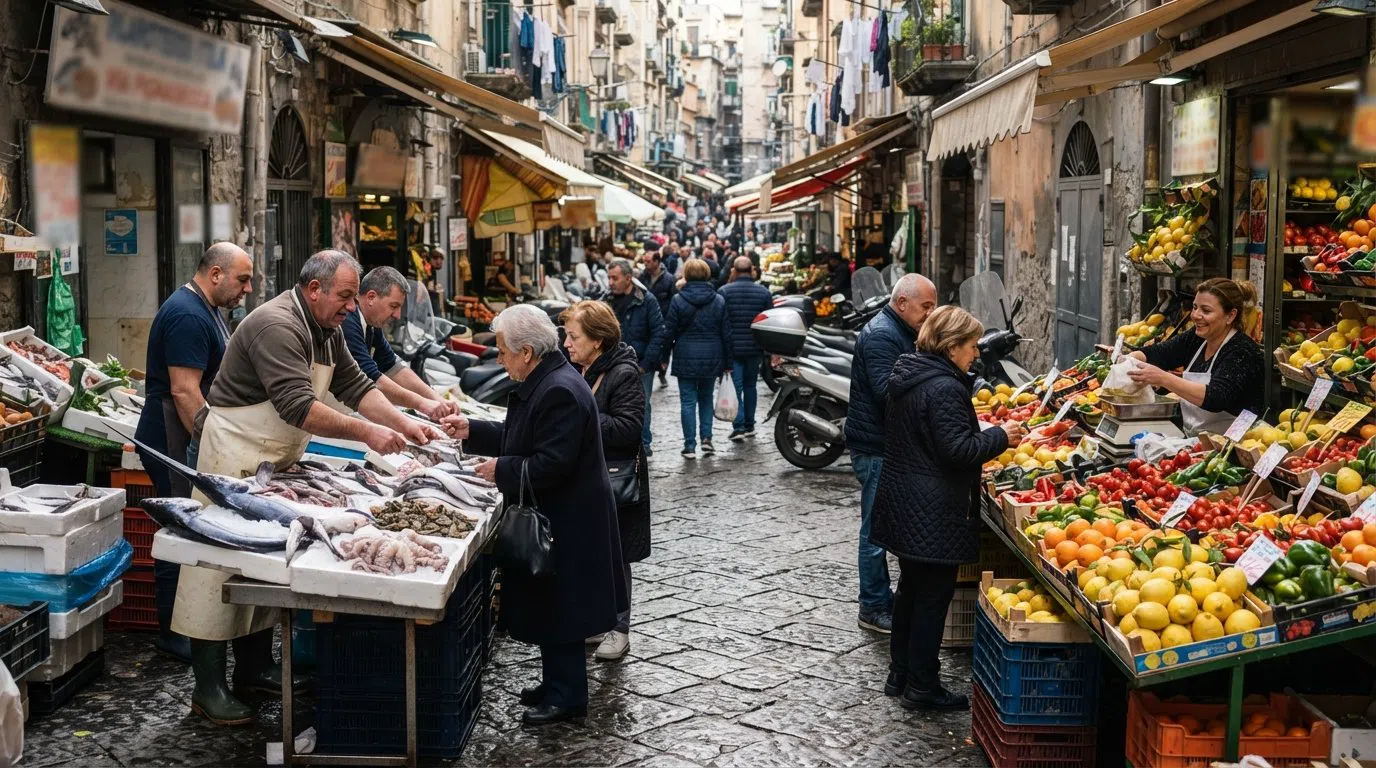
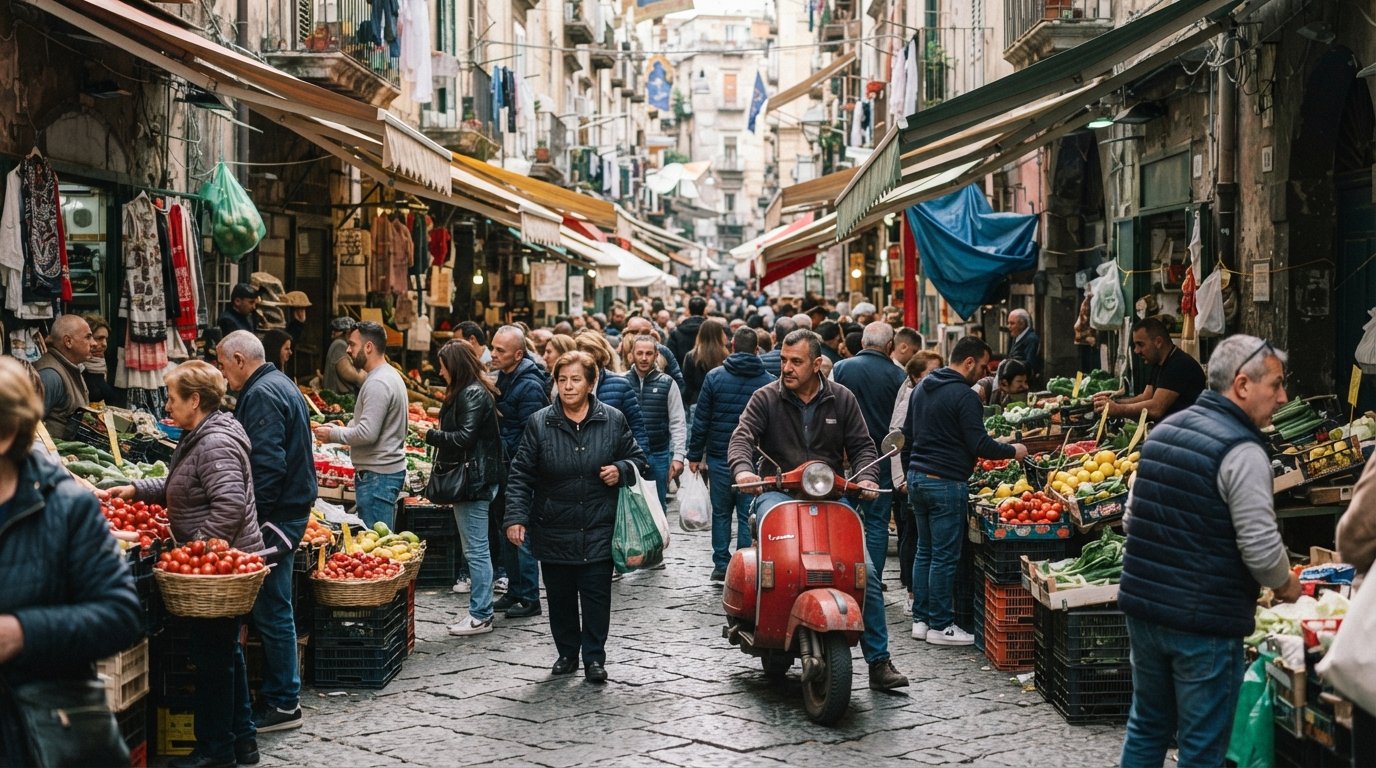
By nine in the morning, Via Pignasecca is already in full throat: fishmongers hosing down crates of anchovies, greengrocers stacking Amalfi lemons the size of fists, and a friggitoria lowering the first basket of dough into hot oil. That is Montesanto, and it does not bother pretending to be anything else. It is a market district, a transport knot, a working slice of Naples where lunch is bought standing up and the day is measured in tickets, queues, and the smell of frying batter.
What Montesanto is known for
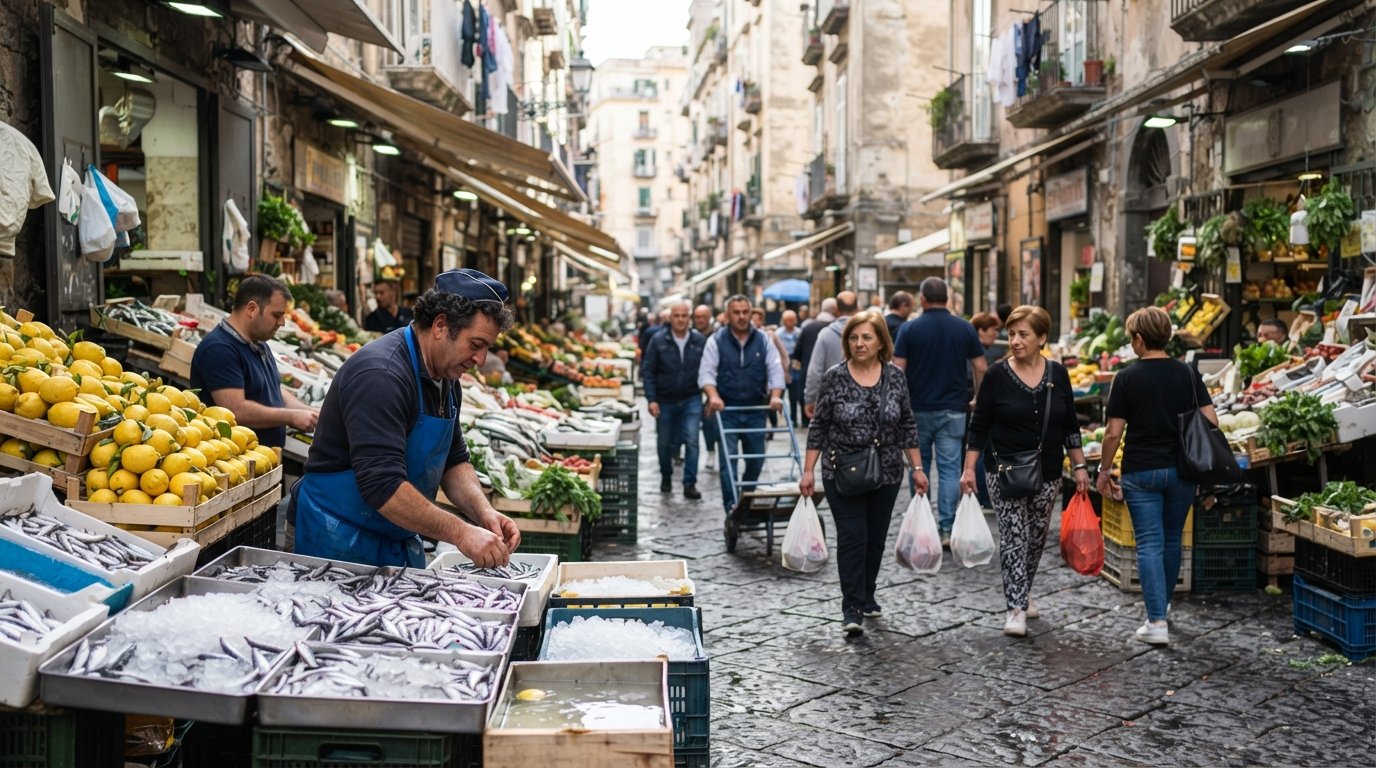
Montesanto lives on two engines: the market and the interchange. The first is La Pignasecca, the oldest street market in central Naples, trading since the 17th century and running along Via Pignasecca and down Via Portamedina. The second is movement — Cumana and Circumflegrea trains terminating at Montesanto station, the funicular climbing out of the same square, Metro Line 2 nearby, and Dante close enough that half the city seems to cut through here sooner or later. Together they make the neighbourhood feel permanently in transit, permanently busy, permanently useful.
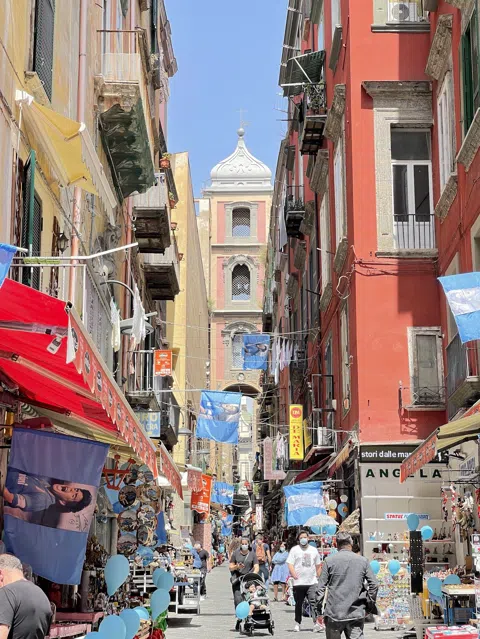
The market is the whole point. This is where ordinary Naples shops for fish, clams, mozzarella di bufala, friarielli, puntarelle, salumi, soap, kitchenware — whatever the day needs. It is not polished, not curated, and not interested in your camera lens. Vendors call prices in dialect over the din of scooters and station foot traffic, and the street narrows into a moving corridor of crates, baskets, and frying oil. If you want calm, go elsewhere. If you want the city with its sleeves rolled up, this is the address.
The transport side gives Montesanto its other pulse. The restored, glass-roofed Montesanto station is where the Cumana and Circumflegrea terminate, and the Funicolare di Montesanto rises from the same square to Vomero. The whole quarter is built around that fact: people arriving, people departing, people cutting across with shopping bags, office workers, students, grandmothers, and food-tour groups all sharing the same pavement. The neighbourhood does not perform local life; it simply is local life.
Overhead, easy to miss if you are looking only at the fish and the frying, sits the Chiesa di Santa Maria di Montesanto, a 17th-century Carmelite baroque church with a dome finished by Dionisio Lazzari in 1680 and the tomb of composer Alessandro Scarlatti. That contrast is very Naples: the sacred above, the market below, both doing their thing without asking permission.
Plan your Naples trip
Live prices from our booking partners.
Guests & rooms
Free cancellation on many rooms. We may earn a commission when you book.
Where to eat & drink
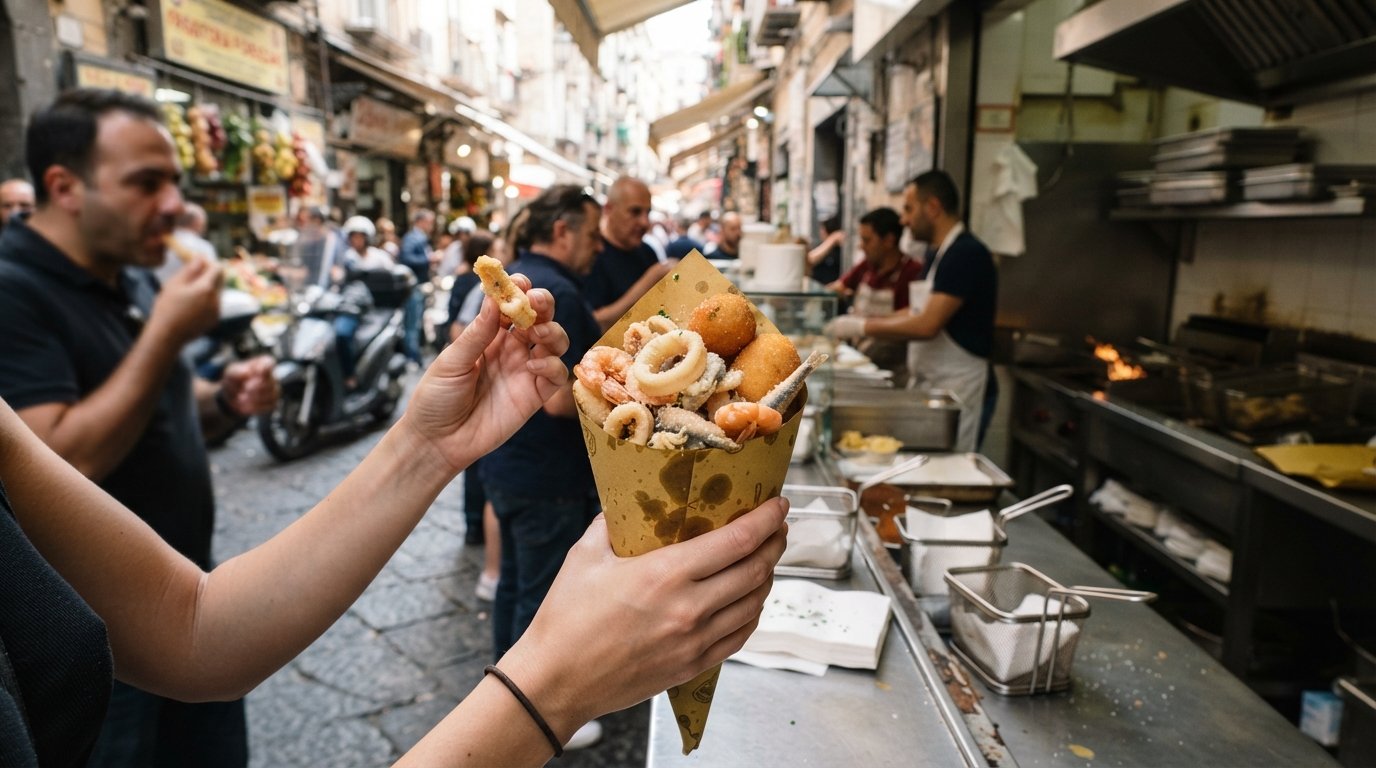
Montesanto is one of the best places in Naples to eat like a local because the food here is not dressed up for the visitor. It is fast, cheap, and rooted in the market. Start with Friggitoria Fiorenzano on Via Pignasecca, a family-run institution frying since the late 1800s. Renato Fiorenzano is the current master fryer, and his oil does not waste time: pizza fritta, panzarotti, crocchè, arancini, the paper-cone cuoppo — all of it made for eating on the hoof. It is also one of the classic places for 'o pere e 'o musso, the old Neapolitan cold cut of boiled pig’s trotter and snout dressed with salt and lemon. No ceremony. Just eat.
A few doors along at Via Pignasecca 14, the same family runs Le Zendraglie, a lunch-only tripperia and trattoria going since 1972. Here the market walks straight onto the plate: trippa al sugo, hearty soups, and Neapolitan classics cooked from what came in that morning. A full meal with wine lands around €18–20, and it is closed Sundays, which tells you plenty about the rhythm of the place. This is not the sort of room that needs to advertise itself. It feeds the people who already know.
Seafood gets its own turn at Pescheria Azzurra on Via Portamedina, where the Gagliotta brothers run a fishmonger by day that becomes an informal fry-shop as the light goes. Order the seafood cuoppo, fritto misto, or whatever is coming out hot at the moment, and take it to one of the pavement tables if you can get one. The point is not refinement. The point is that the fish was a fishmonger’s fish five minutes ago.
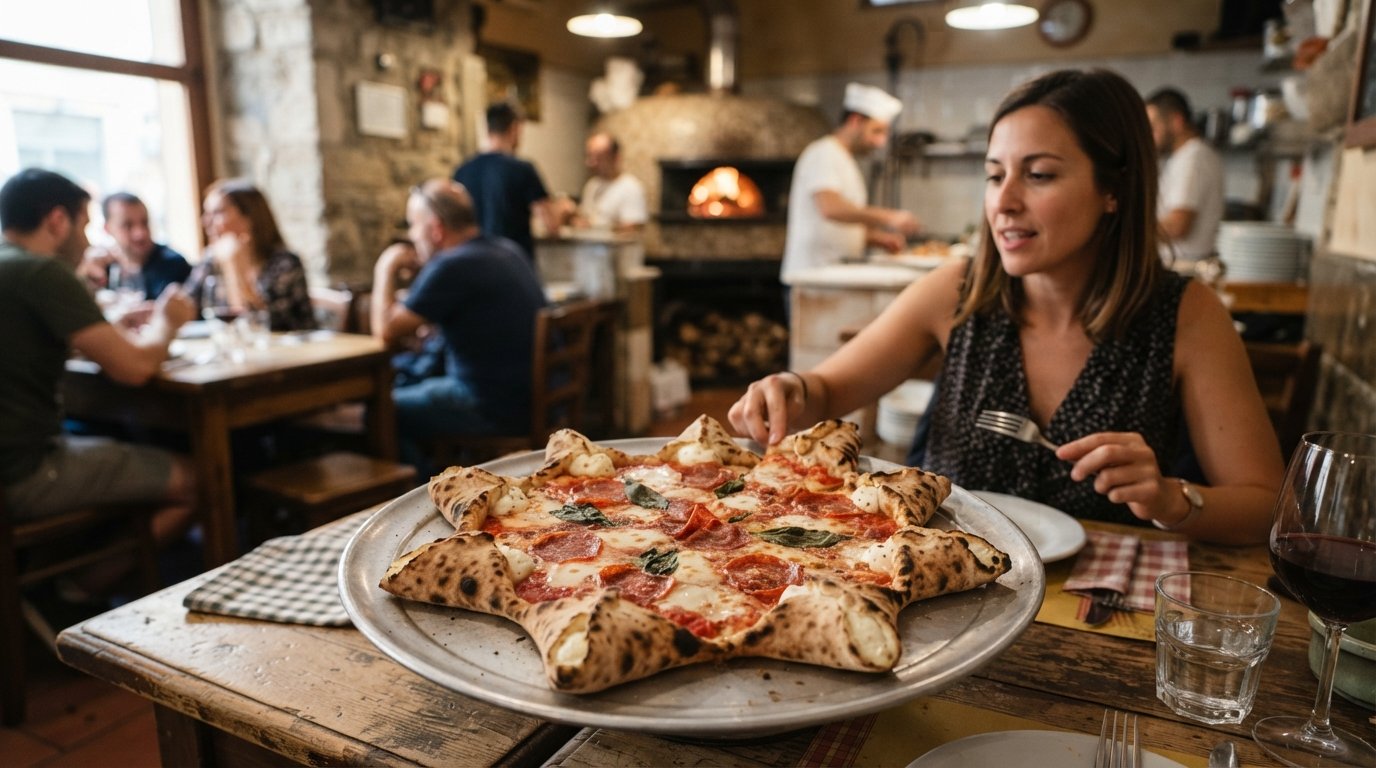
Pizza is covered properly too. Pizzeria Da Attilio at Via Pignasecca 17 is a third-generation wood-fired pizzeria and AVPN-listed, known across the city for its star-shaped Carnevale — a ricotta-stuffed crown around a classic centre. The dough matters here, and it shows. Da Attilio is closed Sundays, so plan accordingly. If you want a more contemporary take, OWAP on Via Pasquale Scura — short for One World All Pizzas — brings travel-inspired pies and a well-regarded vegan menu alongside the traditional margherita. That is the nice thing about Montesanto: the old and the newer both eat here, and both know they are in a neighbourhood that does not care for posturing.
Coffee, naturally, belongs to the daily machinery. On the market’s eastern edge, Caffè Mexico at Piazza Dante has poured Passalacqua-blend espresso since 1953. You buy your ticket at the till first, then hand it over at the bar, and the espresso lands for well under a euro. A tiny ritual, briskly done. Naples would not have it any other way.
Things to do
The first thing to do in Montesanto is simple: walk La Pignasecca end to end and let it feed you in stages. Start where Via Pignasecca meets Piazza Carità, then work down toward Via Portamedina. Do not try to conquer it; graze it. A cuoppo here, a slice of pizza fritta there, a wedge of provolone from a cheese stall, a cone of taralli, and suddenly lunch has become a route. Mornings are best if you want the full market and the freshest fish. By mid-afternoon, stalls begin to pack up and the street loses some of its pressure.
Don’t miss in Montesanto
Montesanto Market
Pedamentina San Martino path base
Stazione Cumana
The second act is vertical. From Piazza Montesanto, take the Funicolare di Montesanto, open since 1891, up to Morghen in Vomero. It is a four-minute climb, roughly 170 metres, for the price of a standard €1.10 city ticket. That is a bargain in any language. At the top, Castel Sant’Elmo waits with its star-shaped fortress and 360-degree panorama over the Bay of Naples and Vesuvius, and next door the Certosa di San Martino gives you baroque cloisters and one of the best views in the city. The whole thing is a neat Naples trick: market noise at the bottom, sky and stone at the top.
Back at street level, go into the Chiesa di Santa Maria di Montesanto if only to step out of the noise for a minute. The interior is baroque, the dome is by Dionisio Lazzari, and the tomb of Alessandro Scarlatti sits there quietly while the market goes on outside. Most people walk past without noticing it. That is their loss.
Montesanto also works as a launch pad on foot. The Quartieri Spagnoli rise immediately to the east, and Via Toledo, Piazza Dante, and the Centro Storico are all within a ten-minute walk. That means you can use the neighbourhood as a base and still drift into the rest of central Naples without planning your day into submission. Here, the city is close enough to touch.
Shopping & markets
Shopping in Montesanto means the market first and last. La Pignasecca is not a place for browsing in the abstract. It is a place to buy lunch, dinner, tomorrow’s lunch, and maybe a bag of taralli on the way home. Along Via Pignasecca and Via Portamedina, six-plus days a week, you can build a whole picnic for a handful of euros at a time and eat as you go. That is the logic of the street: buy, taste, move, buy again.
The fishmongers are the stars — clams, mussels, anchovies, whole bream, squid, much of it landed that morning. Around them are greengrocers piled high with Amalfi lemons, San Marzano tomatoes, friarielli, puntarelle, and the greens that make Neapolitan cooking taste like Neapolitan cooking. Cheese stalls carry mozzarella di bufala and provolone; salumi counters stack capicollo and soppressata. Mixed in are household-goods sellers, cheap clothing, kitchenware, the unglamorous stuff of a working neighbourhood. That is why it feels real. It is not an artisan showcase. It is a market.
Bring cash in small notes. Keep your bag zipped and in front of you in the crush. Taste before you commit, and let the vendors talk you into the day’s best catch. The souvenir here is edible: a wedge of cheese, a bag of taralli, maybe a cuoppo on the walk back to the station. Anything else is just clutter.
Where to stay in Montesanto
Montesanto is a base for value and connections rather than peace. You wake up beside the Pignasecca market and a few steps from the Cumana, Circumflegrea, the funicular, Metro Line 2, and the walk to Dante. That makes it a smart choice if you want to reach the Centro Storico, the seafront, Pompeii, the Phlegraean Fields, and the ferry ports quickly and cheaply. It is also genuinely central, with the Quartieri Spagnoli, Via Toledo, and Piazza Dante close enough to wander to without thinking too hard.
The trade-off is noise and grit. The market starts early, scooters never really stop, and the streets are narrow and busy. Light sleepers should ask for a room set back from Via Pignasecca or the station and bring earplugs. If you want something quieter and still walkable, look toward Piazza Dante or up in Vomero, a funicular ride away.
Hotels in Montesanto
Our best-rated stays in this neighbourhood. Prices are approximate “from” rates — confirmed at the provider when you continue. We may earn a commission if you book through our partners — at no extra cost to you.
In this area In this area
 In this area
 In this area
 In this area
 In this area
Getting around
Montesanto is one of the best-connected pockets in Naples, and most of the time you will do it on foot. The market lanes are tight and walkable, and you can be in the Quartieri Spagnoli, on Via Toledo, or at Piazza Dante within about ten minutes. Montesanto station is the terminus for the Cumana and Circumflegrea suburban railways, useful for the Phlegraean Fields and the western coast. The Funicolare di Montesanto climbs from the same square up to Morghen in Vomero in around four minutes, which is a very Neapolitan way to switch from frying oil to hilltop views.
Metro Line 2 stops here, and Dante on Metro Line 1 is a short walk east. Standard single tickets are €1.10 and valid for 90 minutes across ANM lines and the funicular; a 24-hour pass is €4.50. If you are heading to the airport, Naples Capodichino is roughly 20–30 minutes by taxi or the Alibus airport shuttle from the city centre and the port. There is no direct rail link. And because this is Naples, services can be affected by planned works, so check EAV and ANM before you trust a specific line.
Montesanto is not for people chasing quiet, green space, or a glossy base. It is for people who like their city loud, useful, and edible. It is the kind of place where a cuoppo costs a few euros, a ticket takes you uphill in four minutes, and the day starts with fish being washed down on the pavement. That is the promise, and Montesanto keeps it.
Gallery
Montesanto in pictures
Montesanto — your questions
Is Montesanto a good area to stay in Naples?
Yes, if you want value, food, and transport over peace and quiet. You’re beside the Pignasecca market and steps from the funicular, the Cumana/Circumflegrea trains, and Metro Line 2, with Via Toledo and Piazza Dante close by. The catch is noise, grit, and an early start, so light sleepers should book off the main street and bring earplugs.
What is Montesanto best known for?
For La Pignasecca, the oldest street market in central Naples, running along Via Pignasecca and Via Portamedina. It’s where locals buy fish, produce, and street food like cuoppo and pizza fritta. It’s also a major transport hub, with the Cumana, Circumflegrea, and the Montesanto funicular all right there.
Is Montesanto safe?
By day it’s busy and generally safe, but it’s a working market district, so use normal city caution. Keep bags zipped and in front of you, watch for pickpockets in the crush, and stay alert around scooters and station traffic. At night it’s quieter than the nearby nightlife areas.
What should I eat first in Montesanto?
Start with fried food. A cuoppo or pizza fritta from Friggitoria Fiorenzano is the classic move, seafood from Pescheria Azzurra is excellent when you want something from the bay, and Le Zendraglie is where you sit down for trippa al sugo and market-cooked classics.