The Naples issue
Driving Positano, Amalfi and Ravello in a Day from Naples
Three coast towns, a sea cave and a lemon farm in one run out of Naples, with the door prices, the climbs and the opening hours that decide what order you do them in.

By Katja BrandtThe city before the postcard cropped it
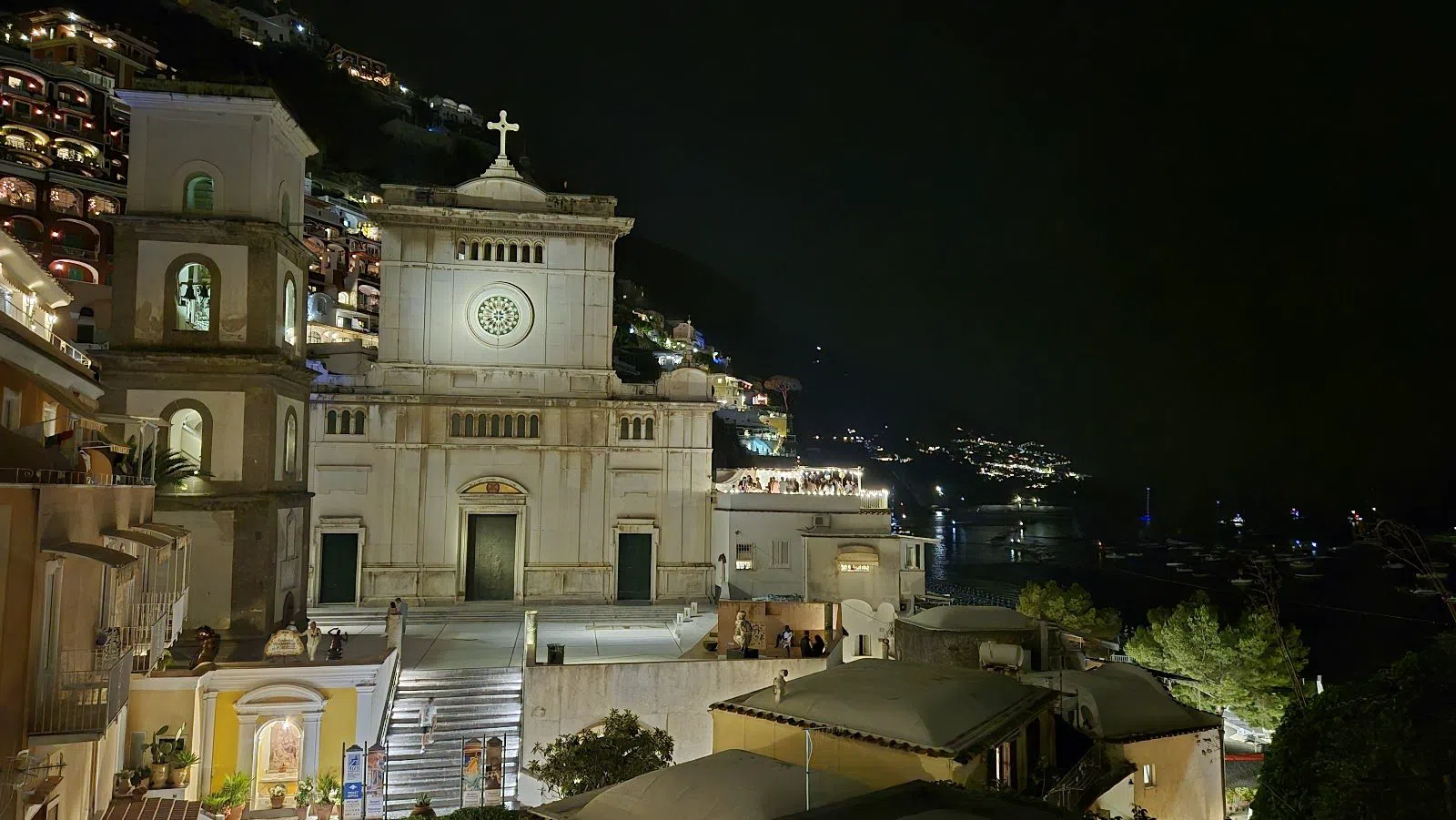
Eleven metres under the church floor in Positano, a Roman dining room still carries a painted sea-creature frieze across red and black walls. The majolica dome above it, tiled in yellow, green and blue Vietri riggiole, is the shape every photograph of the town is aimed at. The church costs nothing and the excavation below costs €15.
Positano on foot
Chiesa di Santa Maria Assunta (Positano) keeps a 13th-century Byzantine icon of the Black Madonna above its altar. Entry is free and it takes walk-ins. Voices come down during Mass, and guides brief their parties outside. Twenty minutes is the standard stop while the driver waits on the road above the town.
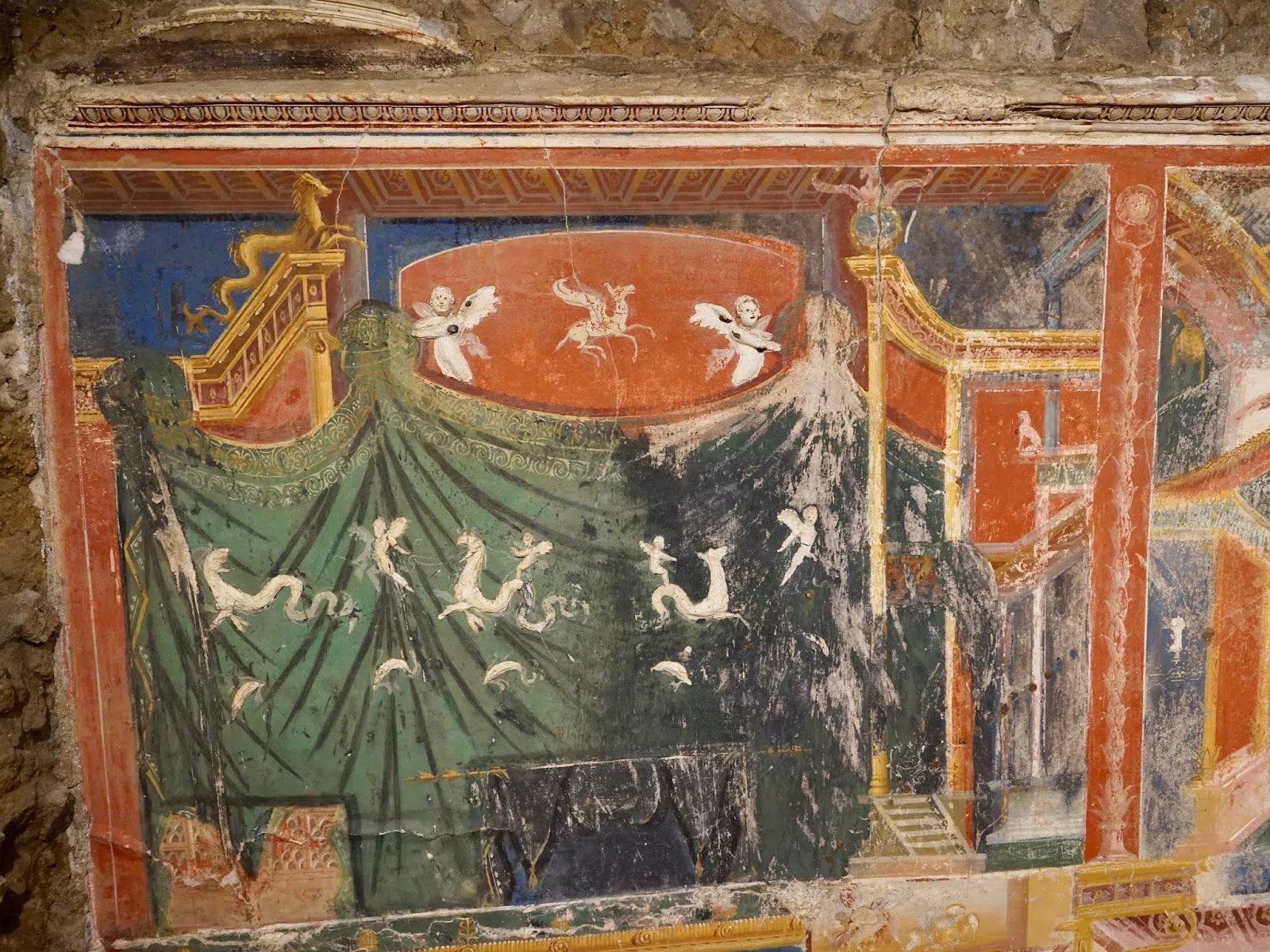
MAR Positano, the Museo Archeologico Romano Santa Maria Assunta, sits directly beneath it. A lit concrete walkway runs down past medieval crypt niches to the frescoed triclinium, where the red and black wall carries its frieze of painted sea creatures. Adults pay €15 and under-12s go free. It opens 09:00 to 21:00 from April to October, and 10:00 to 16:00 from November to March. This is the one indoor, weather-proof sight in Positano, and the best argument for walking down into the town instead of photographing it from above.
The steps below the church drop to Spiaggia Grande (Positano), grey pebbles held in a tight amphitheatre of stacked pastel houses. Orange and blue umbrella rows cover the west side and the wooden ferry jetty closes the far end. The free section is the eastern end, on your right facing the sea. A lounger and umbrella runs €25 to €60 per person. The postcard view of the town is taken from this beach, so the walk down is worth making even if nobody swims.
Via Positanesi d'America leaves the beach and runs five minutes, flat, to Fornillo, cut into the cliff face above the water. The squat round Torre Trasita watchtower stands halfway along. Look back from there and Spiaggia Grande sits under the church dome in one frame. Access is free and unrestricted, and the path stays quiet. It narrows in places, and a large group should walk it in twos.
Plan your Naples trip
Live prices from our booking partners.
Free cancellation on many rooms. We may earn a commission when you book.
The road from Positano to Amalfi
Chiesa di San Gennaro at Vettica Maggiore, in Praiano, is a 17th-century church with a majolica dome, set behind a piazza that hangs over the sea on polychrome tiles in geometric and floral patterns. On a clear day Capri is on the horizon. The SS163 has a driveable lay-by above, which is why cars and coaches halt here. Entry is free and 10 minutes covers it.
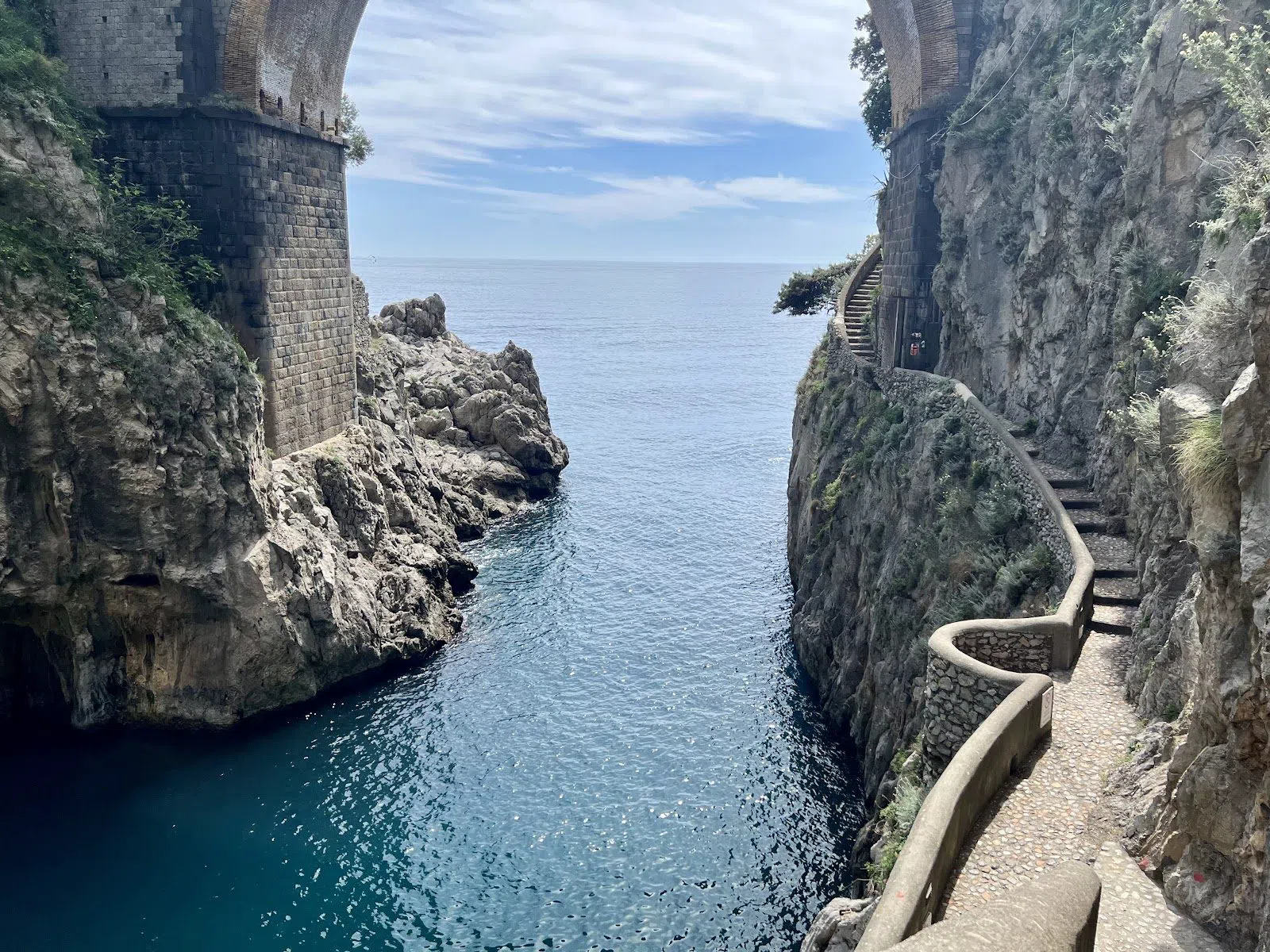
Fiordo di Furore is a deep rock cleft crossed by a single 30-metre stone arch bridge, with old fishermen's houses clinging to the gorge walls and a 25-metre pebble strip at the bottom. Looking down from the bridge is free and takes two minutes. Beach access runs down 200 steps and is periodically restricted for rockfall works. Treat it as closeable without notice.
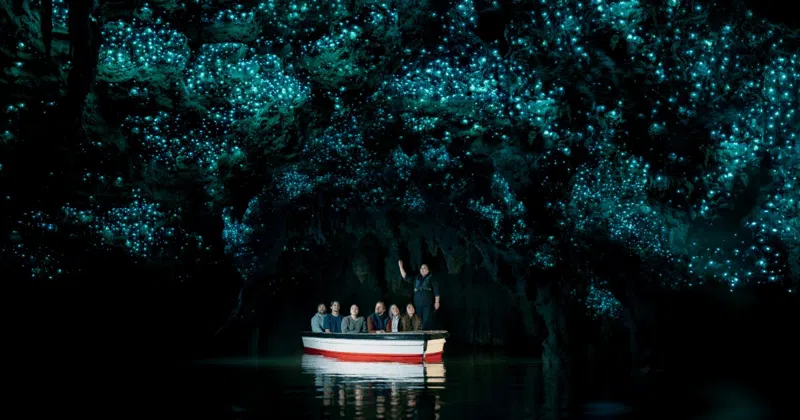
Grotta dello Smeraldo at Conca dei Marini is a flooded limestone cavern lit emerald from below, where light refracts through an underwater opening and stalactites meet their own reflections. A rowing boat with a standing oarsman works the chamber. Boats load in rotation and you are inside for 20 to 30 minutes. Adults pay €7 and children €5, and the lift down from the roadside is included. It opens 09:00 to 16:00 year-round. The cave shuts without warning when the sea is up, so have the driver phone ahead instead of building the day around it.
Amalfi from the cathedral steps to the mill
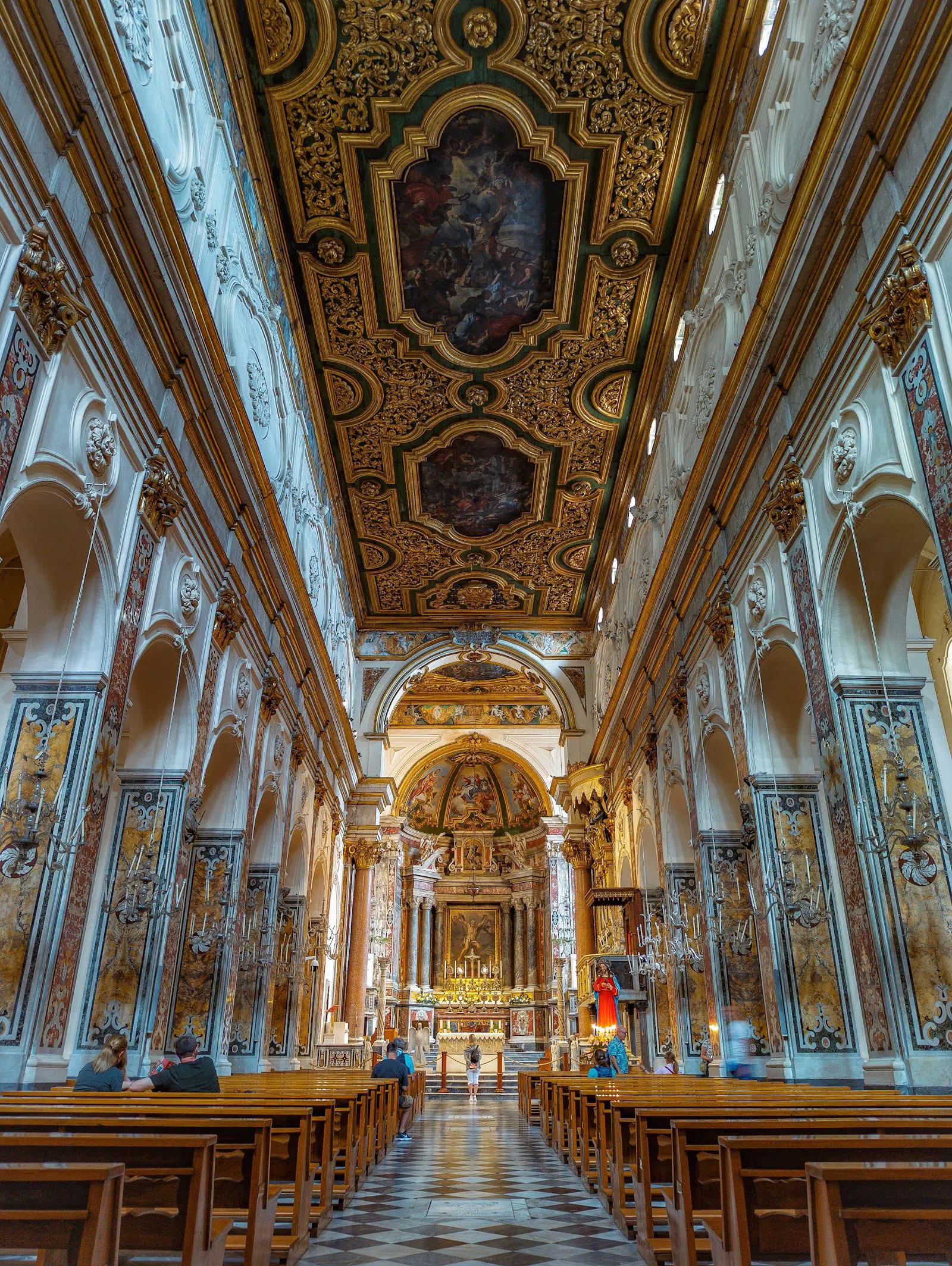
Duomo di Amalfi (Cattedrale di Sant'Andrea) carries a striped Arab-Norman facade of grey and white stone under a gold mosaic gable, reached up 62 steep steps. The cathedral itself is free. A €4 ticket covers the Chiostro del Paradiso, a square of interlaced white pointed arches around palm trees, with the crypt and the Diocesan Museum. The quiet is in the paid half. Most of what there is to see in Amalfi is inside this one complex.
Arsenale della Repubblica, now the Museo della Bussola e del Ducato Marinaro, is two long stone-vaulted medieval boat sheds opening onto the Amalfi seafront. Compasses and Tavole Amalfitane manuscripts sit in lit cases under ribbed tufa arches. Entry is €3, or €1.50 reduced, and a free 30-minute multilingual guided visit comes with the ticket. It runs through winter afternoons and fills the hole left by a closed sea cave.
Museo della Carta is 10 minutes uphill from the cathedral, a 13th-century mill cut into the rock of the Valle dei Mulini. Water-driven wooden hammers knock in stone troughs and dripping cotton-rag sheets go under an iron screw press. The live demonstration is the reason to come. A guided visit in English, Italian, German or French is included in the ticket, which is €7 for adults and €4 for children and students. The mill stays cool indoors while the coast bakes.
Amalfi Historical Garden is a working lemon farm, met at Via Salita per Pontone in Amalfi. Terraced groves step up the hillside on chestnut-pole pergolas between dry-stone walls and old water channels, and a belvedere table looks down on Amalfi's rooftops and the sea. The visit lasts one hour and 30 minutes, with limoncello and lemon-cake tastings. Small-group places start at €90 per person and private bookings at €160. The climb is 150 to 250 steps. Of everything on the drive, this is the stop that explains how the hillside is farmed, and it asks sound knees.

Minori on the climb to Ravello
Pasticceria Sal De Riso stands on the Minori seafront promenade, two minutes off the road up to Ravello. Ricotta-and-pear and lemon-cream cakes fill a glass counter under warm light, and the terrace tables face straight out at the bay. The walk-in counter runs €5 to €12 a head. Large parties cannot reserve a table, and the terrace is comfortable outside the peak lunch hour.
Ravello above the gulf
Duomo di Ravello opens onto an empty piazza behind a plain white front set with 12th-century bronze Barisano doors. Inside, the 1272 Rufolo pulpit stands on carved lions under twisted mosaic columns. The church is free. The crypt museum is €4, or €3 reduced, and takes 15 minutes. Nearly everyone walks past it on the way to the villas.
Villa Rufolo is 30 seconds off the main square, a Moorish cloister of interlaced arches beside a square crenellated tower, with a double-height garden terrace of cypress and hydrangea beds jutting out over the Gulf of Salerno. Adults pay €8. Over-65s pay €6, as do children from 5 to 12, and parties of 15 or more pay €7 a head. Hours were 09:00 to 19:00 daily in late September 2026. The tower museum admits children from age 5.
Villa Cimbrone is a flat 10 to 15 minute walk from the square. The Terrace of Infinity is a straight stone balustrade lined with weathered marble busts, with 350 metres of air and the Gulf of Salerno beyond it. The gardens are open to non-guests at €10 for adults. The terrace is what most people climb to Ravello for, so build the walk into the schedule.
Tickets, doors and cash
MAR Positano goes in small timed groups through a narrow excavation, so a party needs to book ahead; its ticket office is at the foot of the church steps, inside the Luca Vespoli tourist office. Buy the Amalfi cathedral complex ticket only at the official counter inside the doors. Online tickets for the paper mill need 48 hours' notice. Villa Rufolo and Villa Cimbrone sell on site with no advance booking, and Villa Cimbrone takes payment at the garden gate. The sea cave booth takes cash. Out of season the Ravello crypt museum works by email reservation, and in season its desk runs 11:00 to 17:00 from 4 April to 2 November. The churches want shoulders and knees covered, in all three towns.
A private car with a driver runs seven days a week. Single dates do sell out: 16, 17, 18 and 29 October 2026 are gone on the main private day tour, and other dates are still bookable.
Who the day suits
One day is enough for the three towns and the road between them, if you will take steps all day. The run fills eight to nine hours, and every stop on it is built on a slope.
Best time to go
The cathedral staircase and the piazza in Amalfi are the day's pinch point. Go there first thing or late. Light into the sea cave is best from 10:00 to 12:00, and the sun only reaches the floor of the Furore fjord around midday. Take both in the middle of the drive. In summer the free strip at Spiaggia Grande fills before 09:00, so arrive before that or pay for a lounger. Winter shortens the Positano excavation's day, and an early departure matters more then.
Before you set out
Book the Positano excavation and the paper mill ahead, carry cash for the sea cave, and expect the cave to be the one stop the weather can cancel outright. See the Naples guide and the Naples hotel search.
Before you go
How long does the day take?
The run takes eight to nine hours and covers Positano, Amalfi and Ravello, with roadside halts at the San Gennaro piazza in Praiano, the Furore fjord bridge and the Emerald Grotto in between.
Which days can I go, and do dates sell out?
Private day tours run seven days a week, though single dates sell out: 16, 17, 18 and 29 October 2026 are gone on the main private day tour, and other dates are still bookable.
What do the tickets cost at the door?
Positano's church and Amalfi's cathedral nave are free. MAR Positano is €15, the Amalfi cloister and museum complex €4, the Arsenale €3, the paper mill €7, the Emerald Grotto €7, Villa Rufolo €8, Villa Cimbrone €10, and Ravello's crypt museum €4.
What if the Emerald Grotto is closed?
When the sea is up it shuts without warning, and when it is open the boats load in rotation. The Arsenale della Repubblica on the Amalfi seafront is €3, open through winter afternoons, with a free 30-minute guided visit included.
How much climbing is involved?
Positano is a walk down the steps from the church to the beach and back up again. The Amalfi cathedral is 62 steep steps, the lemon farm another 150 to 250, and the Furore beach 200 down. Villa Cimbrone is a flat 10 to 15 minute walk.